The short answer
Click-through rate (CTR) is the share of people who click your ad after seeing it: clicks divided by impressions. For Google Search ads, LocaliQ's 2026 benchmarks put the cross-industry average at 6.64%. But Google itself says a good CTR is relative to what you advertise, so judge yours against your own keywords and your cost per enquiry.
CTR tells you whether your ad earns the click. It does not tell you whether the click was worth paying for. This guide covers both halves, with real numbers from a South African account we manage.
Does this apply in South Africa?
Yes. Click-through rate is calculated the same way in every Google Ads account, and it feeds into the same auction in South Africa as anywhere else. What does not transfer neatly is the benchmarks. The figures most articles quote come from international advertising platforms, and we are not aware of any published South African Google Ads CTR benchmark. So treat outside averages as a rough reference, and use your own account history as the real baseline.
How do you calculate click-through rate?
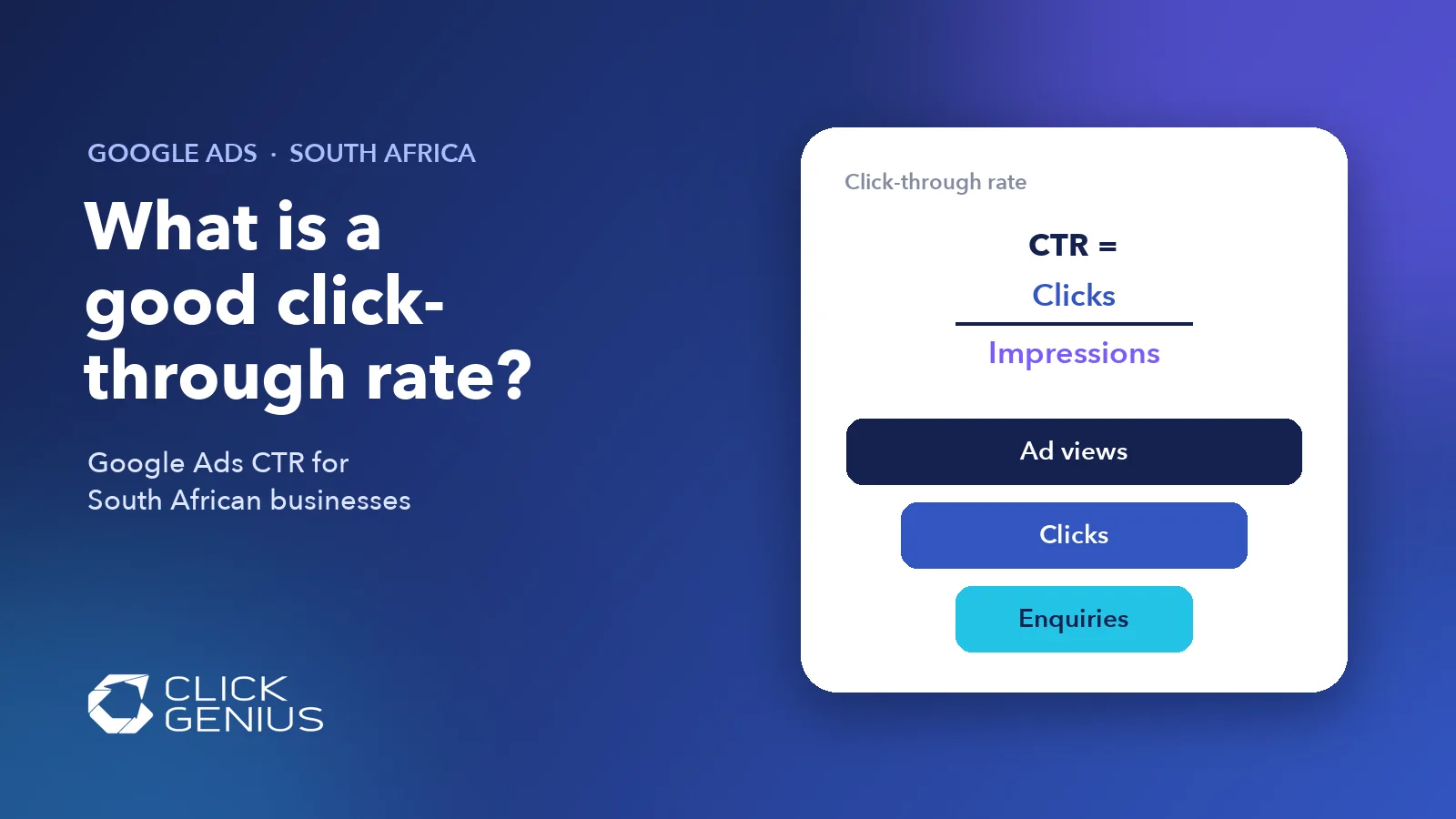
Divide clicks by impressions and multiply by 100. Google's CTR definition page gives the formula as clicks ÷ impressions = CTR, with the example of 5 clicks from 100 impressions giving a 5% CTR.
A South African example: if a Durban dentist's ad for "teeth whitening Umhlanga" is shown 4,000 times in a month and clicked 200 times, the CTR is 200 ÷ 4,000 = 5%.
An impression is counted each time your ad is shown, and a click each time someone clicks it. Some people click and leave before your page finishes loading, which is one reason Google Ads clicks and Google Analytics sessions rarely match exactly.
Here is the same idea with real numbers. This is the full funnel for Better Measure, a Johannesburg corporate events company whose Google Ads we run, over 16 months:
What is a good click-through rate for Google Ads?
For Search ads, anything around or above your industry's average is a reasonable start, but the only fair comparison is your own keywords over time. Google deliberately does not publish a target: its help page says "a good CTR is relative to what you're advertising and on which networks."
The most widely cited figures come from LocaliQ's 2026 search advertising benchmarks, built with WordStream from thousands of its customers' Google Ads and Microsoft Ads campaigns. LocaliQ is a US-based company and the report does not say which countries the data covers, so read these as international reference points, not South African averages:
| Industry (LocaliQ category) | Average Search CTR, 2026 |
|---|---|
| All industries | 6.64% |
| Attorneys and legal services | 5.87% |
| Dentists and dental services | 5.66% |
| Home and home improvement | 6.47% |
| Real estate | 7.61% |
| Automotive repair, service and parts | 5.56% |
| Finance and insurance | 9.83% |
| Travel | 9.32% |
Three things matter more than the table:
- Network. These are Search figures. Display, YouTube and Demand Gen ads are seen by people who were not searching, so their CTRs are normally far lower. Never compare a Display campaign with a Search benchmark. Our Display ads guide explains how those campaigns should be judged.
- Brand versus non-brand. People searching your business name click your ad far more often than people searching "plumber Randburg". Report brand and non-brand campaigns separately, or the brand CTR will hide a weak generic one.
- Position. Ads near the top of the page get clicked more. A CTR drop after you lower bids may be a position change, not a worse ad.
Why does CTR matter in Google Ads?
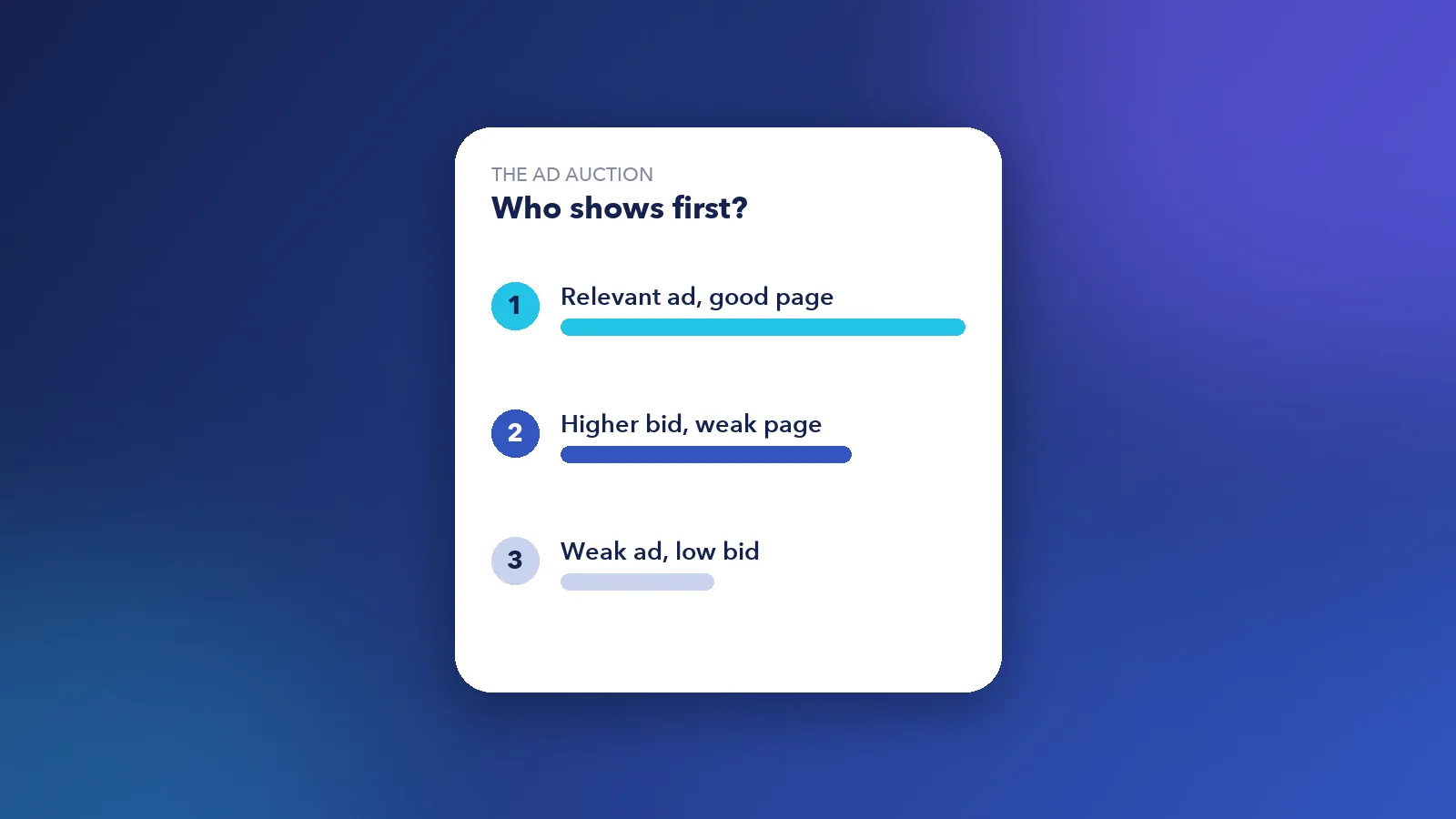
Because Google uses expected CTR when it decides whose ad shows and where. Google's Ad Rank page says your position is based on your bid plus auction-time quality, which can include expected CTR, ad relevance and landing page experience. The CTR page adds that CTR "contributes to your keyword's expected CTR, which is a component of Ad Rank."
In practice, an ad people want to click can hold a good position without the highest bid. We explain the auction in more detail in how Google Ads works.
One common misunderstanding: Quality Score is not the same thing. Google's Quality Score page describes it as a 1 to 10 keyword-level diagnostic and states that it "is not an input in the ad auction." Its "expected clickthrough rate" status (above average, average or below average) compares you with other advertisers who showed for the exact same searches over the last 90 days. Use it to find weak keywords, not as a score to chase.
When is a high CTR a bad sign?
When the clicks do not turn into enquiries or sales. CTR measures the ad, not the business result, and you pay for every click.
Better Measure is the clearest example we have. When we took over the account, our audit found impressions, click-through rate and cost per click were all in a healthy range. The problem was after the click: the main landing page had no enquiry form or call to action, and the contact form was not submitting. Recorded form submissions were zero. A dashboard showing only CTR would have said everything was fine.
High CTR can also mean you are attracting the wrong people. A cleaning company bidding on broad "cleaning" terms may get plenty of clicks from people looking for cleaning jobs, not cleaning services. Check your search terms report and add negative keywords such as "jobs", "vacancies" and "salary" before you celebrate a rising CTR.
How do you improve a low click-through rate?
Make the ad a closer match to what the person searched, and stop showing it to people who were never going to click. Work through these in order:
- Check search terms first. Open the search terms report and add negatives for searches you should never have appeared on. Fewer irrelevant impressions lifts CTR without changing the ad.
- Tighten ad groups. One theme per ad group, so "emergency plumber Sandton" and "geyser installation cost" do not share the same ad.
- Put the search in the headline. If people search "same day courier Cape Town", a headline that says exactly that will usually beat a clever slogan.
- Add assets. Sitelinks, callouts, call and location assets make the ad bigger and more useful. Google lists the expected impact of assets as one of the six Ad Rank factors.
- Give a reason to choose you. Prices from a rand amount, areas you serve, response times or guarantees, but only claims you can back up.
- Check location and schedule. Showing ads in provinces you do not serve, or at 2am for a business that only answers the phone in office hours, wastes impressions and lowers CTR.
- Compare like with like. Judge CTR per campaign and network over at least a few weeks, not across the whole account on one day.
Then judge the result on cost per enquiry or sale. Our Google Ads pricing guide shows how budgets and costs are set in rand.
Frequently asked questions
For a Search campaign, 2% is low next to LocaliQ's 2026 cross-industry average of 6.64%, so it is worth checking your keywords and ads. Display and YouTube ads normally have much lower CTRs than Search, so always compare within the same network and campaign type.
No. A high CTR means people click, not that they buy or enquire. If clicks are not turning into leads, the problem is usually the landing page, the tracking or the search terms you are showing for. Judge campaigns on cost per enquiry or sale.
Indirectly, yes. Google uses expected CTR as part of auction-time quality in Ad Rank, alongside your bid. A more relevant ad can win a good position without outbidding everyone, which tends to keep cost per click down.
CTR is a standard column in the campaigns, ad groups, keywords and ads tables. If you cannot see it, add it through the columns menu. Look at it per campaign and network, not only at account level.
We are not aware of a published South African Google Ads CTR benchmark. The widely quoted figures come from international ad platforms. Your own account history is the most reliable baseline.
The take-away
Click-through rate is clicks divided by impressions, and it matters because Google uses expected CTR in the auction. Use international benchmarks as a rough guide, compare Search with Search and brand with brand, and fix low CTR with tighter keywords, better-matched ads and assets. Then look past the click: a 9% CTR means nothing if the landing page cannot take an enquiry.
Not sure whether your clicks are turning into business? Get a free Google Ads audit, or see how our Google Ads management team builds campaigns around cost per enquiry, with GA4 and conversion tracking set up properly.