The short answer
Choose the SEO agency that can show you real results for a business like yours, explains exactly what it will change and why, lets you own every account and asset, and measures success in leads or sales rather than rankings alone. Walk away from any agency that guarantees first place on Google or will not explain how it builds links.
Google says the same thing in its own guide to hiring an SEO: "No one can guarantee a #1 ranking on Google." The ten questions below turn that advice into a conversation you can have with any South African agency, including us.
Is there a "best SEO company in South Africa"?
No single agency is best for every business. The right agency for a Sandton law firm, a Cape Town e-commerce store and a Durban plumber is rarely the same, because the work, the competition and the budget are different. "Best of" lists are usually written by agencies that rank themselves first. A better question is which agency is best for your goal, your market and your budget, and that is what the questions below are designed to find out.
How to run the selection in 5 steps
Write your goal in business terms before you speak to anyone: "20 more quote requests a month from Gauteng" is a goal; "rank higher" is not. Send the same short brief to three agencies, ask each the ten questions, and compare written proposals rather than sales presentations.
The 10 questions to ask
1. What will you do in the first 90 days, and what should I see by then?
A good agency describes a sequence: an audit, technical fixes, then content and authority work, with leading indicators you can check, such as more pages indexed, more impressions in Search Console and better positions for target terms. Red flag: vague promises of "more traffic" with no plan, or a plan identical to the one sent to every other client.
2. Can you show me results for a business like mine, with real data?
Ask to see a real Search Console or GA4 report from a client in a similar industry, shared on screen with permission, and ask to speak to a current client. Google lists examples of previous work as the first question to ask. Red flag: only screenshots of rankings, unnamed "case studies" or results with no dates.
3. Who will actually work on my account?
The person who pitches is often not the person who does the work. Ask for the names and roles of your day-to-day team, their experience, and how many other accounts they handle. Red flag: a senior strategist in the meeting and an unnamed junior, or an offshore subcontractor, doing the work.
4. How do you build links and authority?
Good answers involve useful content, digital PR, local partnerships, industry directories and fixing broken mentions. Buying links to manipulate rankings breaks Google's spam policies and can get a site demoted. Red flag: "a package of 50 high-authority backlinks a month" or a refusal to say where links come from.
5. Will you tell me what you change on my site, and why?
Google suggests asking whether an SEO will share every change it makes, with the reasoning behind it. Expect a change log and access to the work. Red flag: "secret" or "proprietary" methods, or changes made to your site without telling you.
6. Will I own every account, file and piece of content?
Your business should be the owner of its Google Search Console property, GA4 property, Google Tag Manager container, Google Business Profile and website logins, with the agency added as a user. In Search Console, for example, only owners can add or remove other users, so an agency that holds ownership controls your access. Content and reports you paid for should belong to you. Red flag: the agency sets everything up under its own accounts.
7. How will you report, and what counts as success?
Rankings are a means, not the result. A good report connects organic traffic to enquiries, calls, sales or bookings, which needs proper GA4 conversion tracking. Red flag: monthly reports full of rankings for terms nobody searches, with no link to leads or revenue.
8. What is in the contract, and what happens if we part ways?
Ask about the minimum term, notice period, who owns the work and how handover happens. A short initial term with a clear review point protects both sides. Red flag: a 12-month lock-in before you have seen any work, or penalties for leaving.
9. How do you handle local search and AI search?
Most South African businesses win or lose on local results, so ask how the agency manages Google Business Profile, reviews and location pages. Ask too how it prepares your site to be cited by ChatGPT and Google AI Overviews. Red flag: no answer on either, or AI search sold as a magic add-on with no method behind it.
10. How will you protect our customers' personal data?
An SEO agency working in your analytics, CRM or forms processes personal information on your behalf. Under the Protection of Personal Information Act (POPIA), a business must have a written contract with any operator that processes personal information for it, requiring appropriate security measures. Red flag: the agency has never heard the term "operator agreement".
What progress should look like
Results arrive in a predictable order even if the timing varies. Technical fixes show first, then impressions and rankings in Search Console, then clicks, and finally enquiries. That is why a 90-day review should judge the early signals, not demand a flood of leads, and why an agency that cannot name its early signals is a risk.
Red flags that should end the conversation
- Guaranteed first-page or #1 rankings. Google is blunt: if an SEO guarantees first place, "find someone else".
- Unsolicited emails promising to "fix your SEO". Google specifically warns against SEOs that email you out of the blue.
- Link packages priced by the number of backlinks.
- Ownership grabs: the agency owns your Search Console, GA4, domain or content.
- Reports with no business numbers: rankings and "visibility scores" only.
- Long lock-ins before any results, or exit penalties.
A simple scorecard to compare agencies
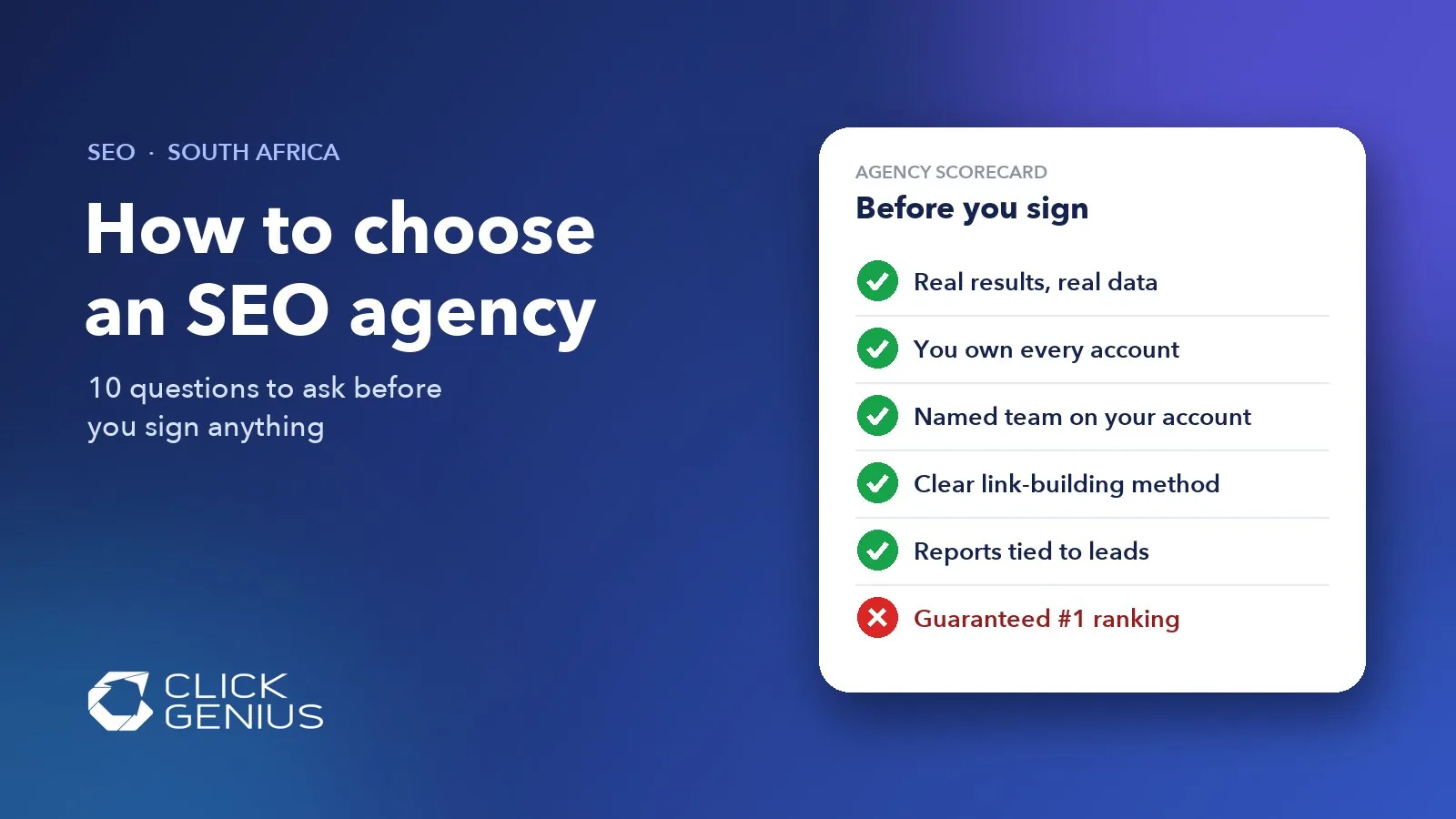
Score each agency 0 (poor answer), 1 (partly) or 2 (clear, specific answer) on each question, then add up. A big gap on questions 2, 4 or 6 matters more than a small difference in price.
| Question | Agency A | Agency B | Agency C |
|---|---|---|---|
| 1. First 90 days plan | |||
| 2. Real results, real data | |||
| 3. Named team | |||
| 4. Link building method | |||
| 5. Transparent changes | |||
| 6. You own everything | |||
| 7. Reporting tied to leads | |||
| 8. Fair contract and exit | |||
| 9. Local and AI search | |||
| 10. POPIA operator agreement | |||
| Total (out of 20) |
We are an SEO agency too, so hold us to this list. We work month-to-month with no lock-in, and local SEO typically starts from around R15,000 a month (see our SEO pricing guide). Start with a free 25-point SEO audit and judge the quality of our thinking before you spend anything.
Frequently asked questions
How much does an SEO agency cost in South Africa?
Prices vary widely with scope and competition. At Click Genius, local SEO for a single-location business typically starts from around R15,000 a month, and national or competitive e-commerce SEO costs more. Very cheap packages often pay for reports rather than work. Our SEO pricing guide explains what drives the cost.
How long does SEO take to show results?
Early signals such as technical fixes, more indexed pages and rising impressions usually show within the first few months. Clicks and leads take longer, depending on your competition and starting point. Agree a 90-day review based on those early signals before judging results on leads.
Should I hire an SEO agency, a freelancer or someone in-house?
A freelancer can suit a small, single-location business with simple needs. An agency suits businesses that need technical, content, local and analytics skills together. An in-house hire makes sense once SEO is a permanent, full-time workload. The same ten questions apply to all three.
Can I switch SEO agencies without losing my rankings?
Yes, if you own your accounts and content and the outgoing agency hands over a record of what it changed. Rankings are tied to your website, not to the agency. Problems arise when an agency owns your Search Console, analytics or content, or removes work when you leave.
Is it safe to hire an agency that guarantees first-page rankings?
No. Google states that no one can guarantee a #1 ranking, and advises finding someone else if an SEO promises first place. Guarantees usually rely on obscure keywords nobody searches or on risky tactics that can harm your site.
The take-away
Choosing an SEO agency is a hiring decision, so treat it like one. Define the goal, give three agencies the same brief, ask the ten questions, score the answers and start with a 90-day review point. The agency that answers clearly, lets you own everything and talks about leads instead of rankings is usually the one worth hiring.
Want a second opinion on proposals you have received? Book a free strategy call and we'll walk through them with you, or explore our SEO services in South Africa.