If your Google Ads account shows strong Performance Max conversions but your overall revenue has not grown to match, you have a problem. The problem is not your ad spend. It is where that spend is going and who authorised the redirect.
Performance Max (PMax) is Google's AI-driven campaign type that runs across every Google property from a single campaign, Search, Shopping, YouTube, Display, Discover, Gmail, and Maps. Google Ads Performance Max campaigns use AI to automatically serve ads across all Google channels from a single campaign. The pitch is compelling: one campaign, maximum reach, Google's AI doing the heavy lifting. For South African businesses running lean marketing teams, it sounds like exactly what you need.
The reality, for many SA advertisers right now, is quite different.
What cannibalisation actually looks like in a live account
Cannibalisation happens when PMax competes with your existing traffic sources for the same users. Instead of finding new customers, it is just moving existing ones around your account.
Here is what that looks like in practice. Your PMax campaign suddenly shows high conversion volume. Your account manager sends a performance report with green arrows everywhere. But your cost per lead has quietly risen, your total revenue has barely shifted, and your dedicated Search campaigns are seeing less impression share than three months ago.
PMax campaigns often get preferential treatment in auctions, meaning they can outbid your Search campaigns for the same keywords, even when your Search campaigns were performing better. Google's auction system does not always reward the campaign with the better quality score when PMax is in the mix. It rewards the campaign Google is commercially motivated to push.
One of the biggest mistakes in early PMax accounts was businesses thinking it was "working," but having no idea where the results were coming from. PMax could claim it generated business, when in reality it was just claiming branded organic search traffic.
This is the single most common finding when Click Genius audits a Google Ads account that has been running PMax alongside Search. The PMax campaign is absorbing brand queries, people who were already going to find you and convert, and reporting those as new conversions. Your cost-per-acquisition looks artificially good. Your actual new customer acquisition is flat.
Why SA advertisers are especially exposed
South African advertisers face a set of compounding pressures that make this problem worse than it might be for a UK or US account.
A unique challenge for South African advertisers includes the fluctuating value of the Rand and local inflation rates, which add further complexity to budget management. When the rand weakens, your cost-per-click in rand terms rises even if the underlying dollar CPC holds steady. That makes wasted spend from cannibalisation proportionally more damaging.
Industry benchmarks show that average pay-per-click costs rose around 10% year-over-year in 2024, jumping from approximately R80 to R88 per click. Alarmingly, 86% of industries experienced significant CPC hikes, with some sectors seeing jumps exceeding 25%, equivalent to R100+ per click in some cases in South Africa.
In competitive SA verticals, property, legal, financial services, healthcare, home improvement, a R150 click that goes to a branded query from an existing customer is not an acquisition. It is a tax on brand recognition you already earned. And if PMax is running without brand exclusions, that is exactly what is happening in your account right now.
Adoption of Performance Max jumped from 60% of surveyed advertisers in 2024 to 71% in 2025. Whether those numbers reflect real incrementality or structural cannibalisation depends entirely on how the account is set up. Most SA agencies set PMax up, let it run, and report on the headline numbers. The problem is the headline numbers look great when cannibalisation is occurring. That is what makes it so hard to catch without a deliberate diagnostic process.
How to diagnose whether it is happening in your account
There are three practical tests any SA business owner or marketing manager can request from their agency.
The brand exclusion test
Add your brand terms as negative keywords at the campaign level inside PMax. Add brand terms as negatives in PMax and measure the impact on your overall branded conversion volume. If total branded conversions do not drop, PMax was cannibalising. If your overall conversion volume stays the same after excluding brand terms from PMax, PMax was never adding incremental value on those queries. It was claiming credit for conversions that would have happened regardless.
The revenue alignment test
If you are seeing more conversions in PMax but your total revenue has not grown proportionally, the conversions are probably coming from existing traffic sources. Pull a side-by-side comparison of total ad spend, total revenue, and total new customer count for the three months before PMax was introduced versus the three months after. If spend went up and revenue tracked sideways, the structural problem is likely cannibalisation.
The channel reporting audit
Channel performance reporting, which rolled out fully in late 2025, now lets you see how each channel is performing, with breakdowns for clicks, conversions, conversion value, and cost. This was a long-requested feature and makes it easier to understand where your spend is actually going.
Use this report. If you find PMax is allocating a significant portion of budget to Display and YouTube when your goal is lead generation or direct sales, that is a signal the algorithm is optimising toward low-intent inventory. Your PMax campaign might be spending 70% of its budget on Display and YouTube inventory while you assume it is competing on Search.
Book a free Google Ads audit for South African businesses, we'll check for brand-query cannibalisation, channel-spend leakage, missing negatives and conversion-tracking gaps.
The structural fix most SA agencies are not implementing
The highest-performing Google Ads accounts in 2026 almost always run both Performance Max and Search campaigns. Search captures high-intent demand. PMax captures incremental demand across channels. Together, they cover the full funnel without leaving money on the table.
The key word there is incremental. PMax should be finding audiences and queries your Search campaigns are not reaching, not fighting over the same R100 keywords your Search campaign was already winning.
Here is the account structure that actually works for SA advertisers:
Your Search campaigns should own your branded keywords, your highest-converting non-branded terms, and any competitor terms you are actively targeting. These are controlled environments where you need intent precision and predictable cost-per-lead. Run dedicated Search campaigns for your highest-value keyword themes, branded terms, top-converting non-branded queries, competitor terms, and use PMax to cover everything else, including Shopping, Display, YouTube, and incremental Search coverage.
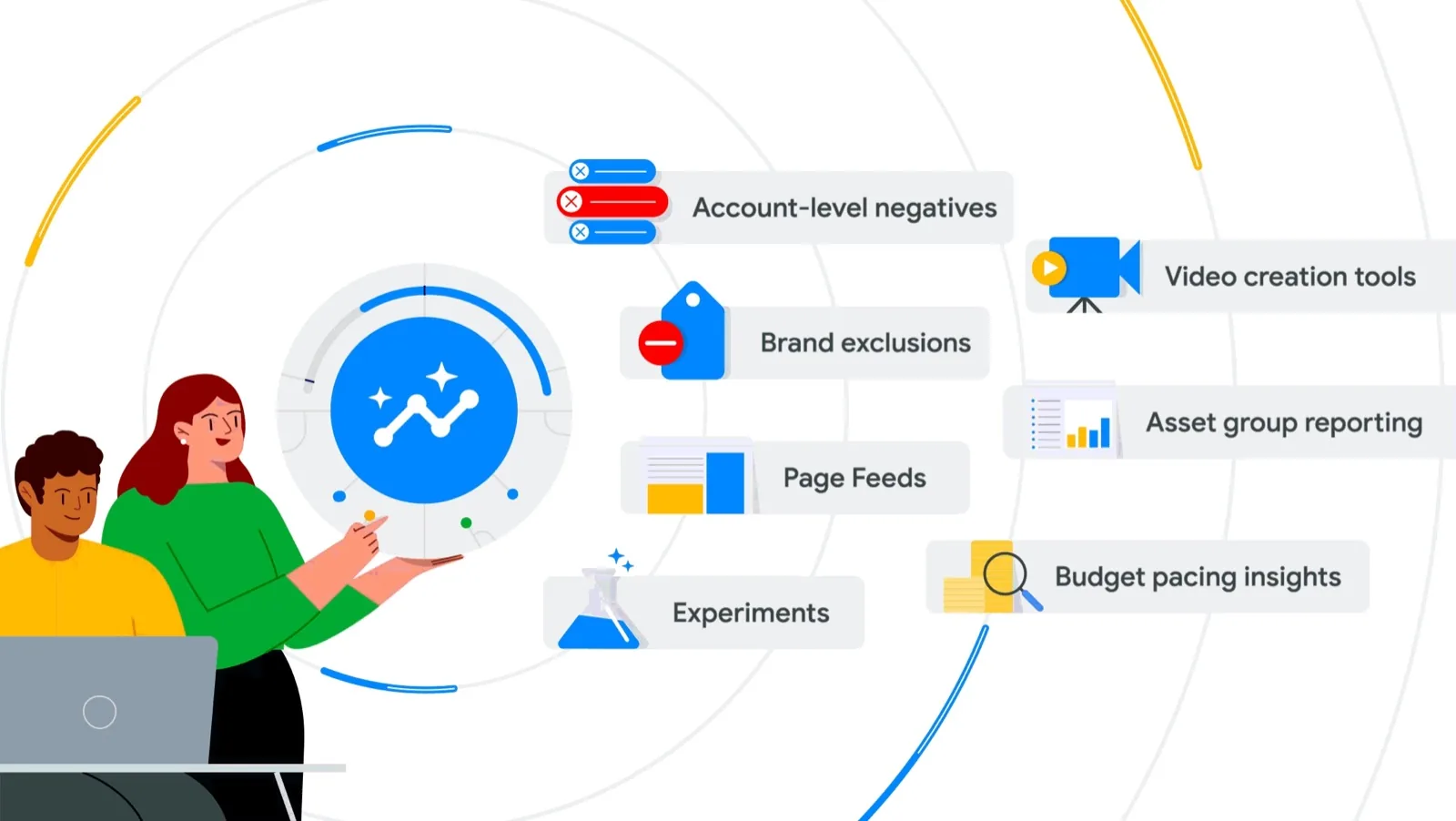
Run brand terms exclusively through Search campaigns and use account-level negative keywords to block them from PMax. Monitor search term overlap regularly. Ensure your PMax campaigns are focused on incremental reach, not duplicating what Search already covers.
On the PMax side, your account needs five things in place before the campaign can do useful work:
1. Campaign-level negative keywords
As of January 2025, campaign-level negative keywords are available to all advertisers. This is no longer a beta feature. If your agency has not implemented them, ask why.
2. Brand exclusions on Search text ads
If you are a retailer, keep Shopping ads open while blocking branded Search text ads. Previously, brand exclusions applied to both Search and Shopping ads. You can now apply brand exclusions to just Search text ads, while keeping branded traffic for Shopping ads.
3. Customer Match data as audience signals
This is your strongest signal. Upload your existing customer emails. Google finds similar users. This is the difference between PMax finding genuinely new customers versus recycling your current ones.
4. Search themes set correctly per asset group
Search themes are Performance Max's version of keyword guidance. Add up to 50 search themes per asset group, these are terms your customers actually use. Without them, you are letting the algorithm guess at your business.
5. Proper conversion tracking, not just GA4 imports
Use Google Ads Conversion Tracking, not just Google Analytics imports. The Google Ads tag captures more conversions due to different attribution models, which means better algorithm training. A PMax campaign trained on inaccurate conversion data will optimise toward the wrong thing indefinitely.
There is a second problem arriving for SA advertisers right now
While the PMax cannibalisation issue is costing SA businesses money today, a related development is reshaping the competitive landscape in ways most local advertisers have not prepared for.
Google quietly rolled out advertising within AI Overviews to 12 markets beyond the US, including South Africa. This happened in December 2025 via a documentation update, with no public announcement and no fanfare.
As of early 2026, ads can appear in three positions relative to AI Overviews: above the AI Overview, below it, and within the AI-generated summary itself. The above and below placements are available in all 200+ markets where AI Overviews exist.
What this means practically: the search results page your customers see today in South Africa is not the same page it was twelve months ago. AI Overviews now appear above traditional results for a growing share of queries. Google's AI Overviews are pushing both organic and paid results further down the page.
For SA advertisers, there is a nuance here worth understanding. You cannot specifically opt into or target AI Overview ad placements. You also cannot opt out. Your existing text and Shopping ads from Search, Shopping, and Performance Max campaigns are automatically eligible if they meet Google's relevance and quality thresholds.
This means ad quality, landing page relevance, and campaign structure have become more important, not less. Informational and educational searches that trigger AI Overviews are becoming less efficient from a paid search perspective, especially when AI-generated answers satisfy user intent before a click occurs. Advertisers should prioritise stronger bids for high-intent, conversion-focused queries like pricing, demo, apply, book, or near me searches.
For a Sandton law firm, a Johannesburg property developer, or a Cape Town B2B software company, this changes where you put your money. Generic informational keywords are increasingly going to be consumed by AI Overviews before a user reaches your ad. High-intent, action-oriented keywords with strong landing page alignment are where the paid search budget needs to concentrate.
What to ask your Google Ads agency right now
If you are spending more than R15,000 per month on Google Ads in South Africa and running PMax alongside Search campaigns, these are the five questions you should be asking your agency in your next review:
- What is our brand query exclusion setup inside PMax, and can you show me the configuration?
- Pull the channel-level breakdown from PMax. What percentage of spend and conversions is coming from Display and YouTube versus Search and Shopping?
- Show me total new customer acquisition over the last six months compared to total Google Ads spend. Not total conversions. New customers.
- What search themes are set at the asset group level, and when were they last reviewed?
- Are we using Google Ads native conversion tracking or relying on GA4 imports as our primary conversion signal?
Advertisers who know how to use the controls now have meaningful leverage, and those who do not are still flying blind while Google spends their budget across its entire network.
That is not an exaggeration. Google's incentive is to spend your budget. Your incentive is to grow your business. When PMax is configured correctly, those incentives align. When it is not, Google wins and you pay.
Our Google Ads management services in Johannesburg include monthly PMax audits, brand-exclusion configuration, search-theme tuning and channel-level reporting, built for SA budgets and SA buyer intent.
The bottom line for South African business owners
Performance Max is not a bad product. Configured correctly with proper exclusions, accurate conversion data, real audience signals, and a Search campaign structure that protects your high-intent terms, it can extend your reach meaningfully across channels your Search campaigns cannot touch.
But "configured correctly" is doing enormous work in that sentence. Automation handles bids and placements, but it cannot tell you whether your offer is compelling, your landing page reduces friction, or your funnel actually makes sense. That requires a practitioner who understands your business, not a platform that is optimising toward its own revenue targets.
The SA advertisers who are going to win in 2026 are not the ones spending the most on Google Ads. They are the ones whose agencies have set up structural controls that force PMax to find genuinely new customers, protected their Search campaigns from AI-driven budget dilution, and positioned their high-intent ads correctly for a SERP that looks fundamentally different than it did two years ago.
If your current Google Ads setup has not been audited against these criteria in the last 90 days, there is a strong chance you are paying for conversions you were already going to get.
Frequently asked questions
How do I know if Performance Max is cannibalising my Search campaigns in South Africa?
Run the brand-exclusion test: add your brand terms as negative keywords inside PMax for two weeks. If your total branded conversion volume stays flat, PMax was claiming credit for traffic that would have converted anyway. Combine that with a revenue-alignment check, if PMax conversions are up but total revenue and new customer count are flat, you have a cannibalisation problem.
Should South African advertisers run Performance Max and Search campaigns together?
Yes, but only with structural controls in place. Search should own branded queries, top-converting non-branded keywords, and competitor terms. PMax should be configured with campaign-level negative keywords, brand exclusions, Customer Match audience signals, search themes per asset group, and native Google Ads conversion tracking. Without those guardrails, PMax will compete with Search for the same auctions and inflate your cost per acquisition.
Can I see how much of my Performance Max budget is going to Display and YouTube?
Yes. Channel performance reporting rolled out fully in late 2025 and now shows clicks, conversions, conversion value and cost broken out by channel inside PMax. If your goal is lead generation and you see a large share of spend going to Display and YouTube, the algorithm is optimising toward lower-intent inventory and the campaign needs restructuring.
How are AI Overviews changing Google Ads for South African businesses?
Google rolled out AI Overview ad placements to South Africa in December 2025. Ads now appear above, below and within AI-generated summaries automatically, you cannot opt in or opt out. Informational queries are increasingly answered by AI before a click occurs, so SA advertisers should concentrate budget on high-intent, action-oriented keywords like pricing, demo, book, apply and near me searches with strong landing page alignment.
What is the minimum Google Ads spend where PMax cannibalisation becomes a serious financial risk?
For South African advertisers spending more than R15,000 per month with both PMax and Search running, the cost of unchecked cannibalisation typically exceeds the cost of professional management. In competitive verticals like property, legal, financial services and healthcare, where CPCs can exceed R150, even smaller accounts should audit for brand-query cannibalisation.
The take-away
At Click Genius, we audit SA Google Ads accounts for exactly this set of structural risks, brand-query cannibalisation, channel-spend leakage, missing negatives, and AI Overview readiness. If you are running PMax alongside Search and you are not sure whether the two are working together or against each other, find out before the next billing cycle.
Book a free Google Ads audit, we'll review your PMax configuration, your Search campaign protection and your conversion-tracking setup, and tell you exactly what to fix first.