The short answer
Google Ads now lists Search and Performance Max as supported campaign types for user-based Conversion Lift, a test that measures how many conversions your ads actually caused rather than how many they were credited with. It needs at least 1,000 observed conversions and a US$5,000 study budget, so most South African small and mid-sized accounts will not qualify yet. They can still run simpler tests that answer the same question.
What changed
Google rewrote its help page Set up Conversion Lift based on users, which now lists Search and Performance Max alongside Display, Video, Demand Gen and App campaigns. iOS App campaigns and Travel ads are excluded.
The change was spotted by PPC News Feed's Hana Kobzová and reported by Search Engine Roundtable on 8 October 2026 and by Search Engine Land. According to that reporting, Search and Performance Max studies previously needed a Google representative to set up. We have not seen a separate Google announcement, so the help page is the primary source here.
What Conversion Lift actually measures
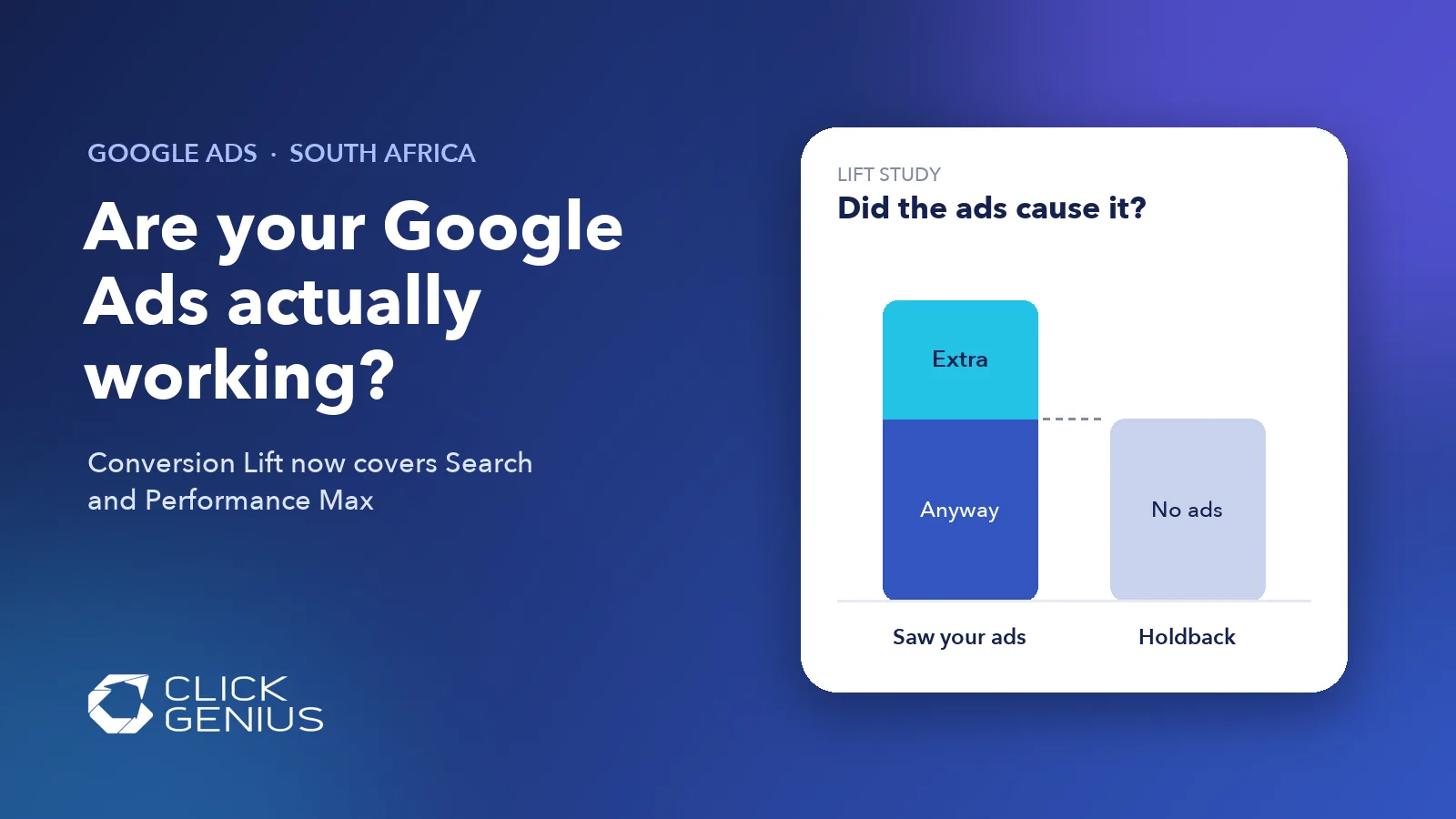
Conversion Lift measures incrementality: the conversions that would not have happened without your ads. Google splits eligible users into two groups. One group can see your ads; a holdback group does not. The difference in conversions between the two groups is the lift. Google describes it as measuring "the incremental number of conversions, site visits, and any other action directly driven by your ad".
This matters because the conversions column in Google Ads shows attributed conversions, not caused ones. A branded search ad, for example, often gets credit for a customer who typed your business name and would have found your website anyway. Attribution answers "which ad was involved?". Incrementality answers "would we have lost this customer without the ad?". The second question is the one that decides whether your budget is well spent.
Can a South African account qualify?
Most South African small and mid-sized accounts will not meet the thresholds yet. These are the requirements on Google's help page:
| Requirement | What Google asks for | What it means in South Africa |
|---|---|---|
| Observed conversions | At least 1,000 (conversions with supplementary data don't count) | A clinic or law firm getting 60 leads a month is far below this. |
| Study budget | At least US$5,000 | Roughly R80,000 or more at late-September 2026 exchange rates. |
| Conversion action | At least one action compatible with Conversion Lift | Your conversion tracking has to be clean before you start. |
| Duration | As short as 7 days; Google typically recommends more than 14 | Longer for services with long decision cycles, such as dental implants or property. |
| Holdback | 1% to 50% of users see no ads | You accept fewer conversions during the test in return for a real answer. |
Larger South African e-commerce stores, national retailers and high-volume lead generators can reach these numbers. For a typical service business spending around R15,000 to R50,000 a month on Google Ads, the conversion threshold is the main barrier, not the budget.
How to test incrementality if you don't qualify
You can answer a smaller version of the same question with tools every advertiser already has. None of these is as clean as a randomised lift study, but each one is better than trusting the conversions column alone.
| Method | Best for | Main caveat |
|---|---|---|
| Google Ads custom experiment (50/50 split) | Testing a change, such as a bid strategy or broad match, inside a Search campaign | Compares two versions of a campaign, not ads versus no ads |
| Geographic holdout | Businesses serving several cities or provinces | Regions differ, so compare against each region's own history |
| Brand campaign pause test | Checking whether branded search ads bring in new customers | Competitors bidding on your name can distort the result |
| CRM and Search Console cross-check | Lead-generation businesses with a CRM or enquiry log | Directional only; seasonality and other channels interfere |
1. Run a custom experiment
Google's custom experiments work for Search, Display, Video and Hotel campaigns, and Google recommends a 50% split. Use them to test whether a change improves results before you roll it out, for example switching a Johannesburg plumbing campaign from manual bidding to Maximise Conversions.
2. Hold back a region
If you advertise in several areas, pause ads in one comparable area for four to six weeks and compare its enquiries against its own previous weeks and against the areas where ads kept running. A national furniture retailer could hold back one province; a dental group could hold back one practice's suburb. Google also offers a geography-based Conversion Lift beta for campaigns that target a single country, but its help page does not say which countries are included.
3. Test your brand campaign
Pause branded keywords for two to four weeks and watch total enquiries, not just Google Ads conversions. If total leads barely move, much of that spend was paying for customers you already had. If competitors start appearing on your name and leads drop, the brand campaign is protecting you and worth keeping.
4. Cross-check against your CRM
Compare Google Ads conversions with the leads your team actually recorded, and with branded clicks in Search Console. If Google Ads claims more leads than your reception desk received, you have a tracking problem to fix before any test can be trusted.
Fix your tracking before you test anything
Every incrementality test is only as good as the conversion data feeding it. Common problems include duplicate conversion actions, page views counted as leads, and phone calls that are never tracked. Fix those first: one primary conversion per real business outcome, enhanced conversions where possible, and offline conversion imports if your sales happen on the phone or in person. Our analytics and tracking setup service covers this, including lift studies for larger budgets.
What is still unclear
Two things are not settled. First, the same help page that now lists Search and Performance Max still says "Conversion Lift isn't available for all Google Ads accounts" and points advertisers to a Google representative, so self-serve access may vary between accounts. Second, Google has not said whether access is rolling out gradually or by country. If you meet the thresholds, check the Experiments section of your account under Lift studies rather than assuming you have access.
What to do this month
- Check your observed conversions over the last 90 days. If you are near 1,000 and spend enough, look for Lift studies under Campaigns, then Experiments.
- Audit your conversion actions so that only real leads and sales count as primary conversions.
- Pick one question to answer, such as "Does our brand campaign bring new customers?" or "Is Performance Max adding sales or taking credit for Search?"
- Choose the test that fits your size from the table above and agree the dates with whoever handles sales, so lead counts are recorded consistently.
- Decide in advance what result will change your budget, so the test leads to a decision rather than a debate.
If Performance Max is part of the question, read our guide to Performance Max cannibalising Search campaigns first. That overlap is one of the most common reasons attributed conversions look better than real results.
Our free Google Ads audit checks your conversion tracking, brand spend and Performance Max overlap, and tells you which incrementality test makes sense for your budget. You get it within 48 hours.
Frequently asked questions
What is Conversion Lift in Google Ads?
Conversion Lift is a Google Ads study that splits users into a group that can see your ads and a holdback group that cannot. The difference in conversions between the two groups shows how many conversions your ads actually caused, rather than how many they were credited with.
Can I run Conversion Lift on Search and Performance Max campaigns?
Yes, Google's help page now lists Search and Performance Max as supported campaign types for Conversion Lift based on users. Your account needs at least 1,000 observed conversions, a study budget of at least US$5,000 and a compatible conversion action, and Google says the feature is not available for every account.
Is Conversion Lift available in South Africa?
Google's help pages do not list country restrictions for user-based Conversion Lift, but they do say it is not available for all accounts. The practical test is to look for Lift studies in the Experiments section of your Google Ads account. If you meet the thresholds and cannot see it, ask your Google representative.
How do I know if my Google Ads are actually working without a lift study?
Compare Google Ads conversions with the leads or sales your business actually recorded, then run a smaller test such as a custom experiment, a regional holdout or a brand campaign pause. Each one gives a directional answer about whether your ads bring in customers you would not have won otherwise.
Should I stop bidding on my own brand name?
Not without testing it. Branded ads often take credit for customers who would have found you anyway, but they also protect your name when competitors bid on it. A two to four week pause, measured on total enquiries rather than Google Ads conversions, gives you a real answer for your business.
The take-away
Google putting Search and Performance Max into Conversion Lift is a sign that incrementality, not attributed conversions, is becoming the standard way to judge ad spend. Most South African businesses cannot run the official study yet, but every advertiser can clean up their tracking, pick one question and test it properly. That is how you find out which part of your Google Ads budget is earning its keep.
Want to know what your account would show? Get a free Google Ads audit, or see how our Google Ads management in South Africa works.